

Coalition infrastructure refers to the systems and processes that help networks of organizations coordinate effectively at scale. Without it, even well-funded and well-intentioned networks struggle to maintain alignment, support members, and operate as cohesive systems.
Coalitions are complex. They are not direct service providers. They are not data warehouses. They are not case management systems. Instead, coalitions are coordination systems. Whether focused on homelessness, human trafficking, emergency preparedness, or other initiatives, coalitions exist to bring together independent organizations and help them function as a more aligned, effective network.
For coalitions looking to strengthen how they manage data, communication, and coordination, building strong infrastructure starts with understanding what responsible, consistent practices actually look like.
Across sectors, coalitions are responsible for supporting the organizations that deliver frontline care. Their role is to:
This work happens at the network level as opposed to any single program. Continuums of Care (CoCs), for example, are federally recognized planning bodies responsible for coordinating homelessness services across communities.
When coalitions like these function well, service providers are better equipped, more informed, and more aligned. When they struggle, even strong individual programs can become disconnected from the broader system.
Since coalitions don’t control their members but rather support them. That distinction creates a unique operational challenge.
Each member organization may have:
Research on U.S. homelessness systems, for example, shows that shared data and coordination structures are essential for collaboration, but differences in capacity and resources across organizations often create uneven participation and misalignment. Coalitions are responsible for bringing those differences into alignment without adding unnecessary burden. In practice, that means:
This is coordination work at scale.
Many coalitions are still relying on a patchwork of tools to manage this complexity:
Over time, this creates real friction:
This challenge isn’t about lack of effort or commitment. Rather, it is about systems, structures, and tools that were never designed for the realities of grant-funded nonprofit work. In our article Why Grant-Funded Nonprofits Struggle with Data, we further explore these challenges and offer practical, mission-aligned solutions.
Effective coalitions need systems that are built for network-level operations, not individual program delivery. Strong coalition infrastructure should support:
A clear, up-to-date view of member organizations, contacts, and roles across the network.
Coalitions provide ongoing support, training, and technical assistance to members. However, without a structured way to track it, that work becomes invisible. Infrastructure should allow coalitions to:
Coalitions develop and share guidance, tools, and best practices. Those resources need to be:
Coalitions are responsible for keeping members informed and aligned. That requires:
Coalitions need to support data consistency. That means:
Standardized systems and shared infrastructure have been shown to improve coordination, accountability, and collective decision-making across multi-organization networks.
Coalition Manager is designed specifically to support coalition-level operations. It provides a centralized environment where coalitions can:
Rather than replacing member systems, Coalition Manager helps coalitions create alignment across them.
Coalitions are often asked to do more each year:
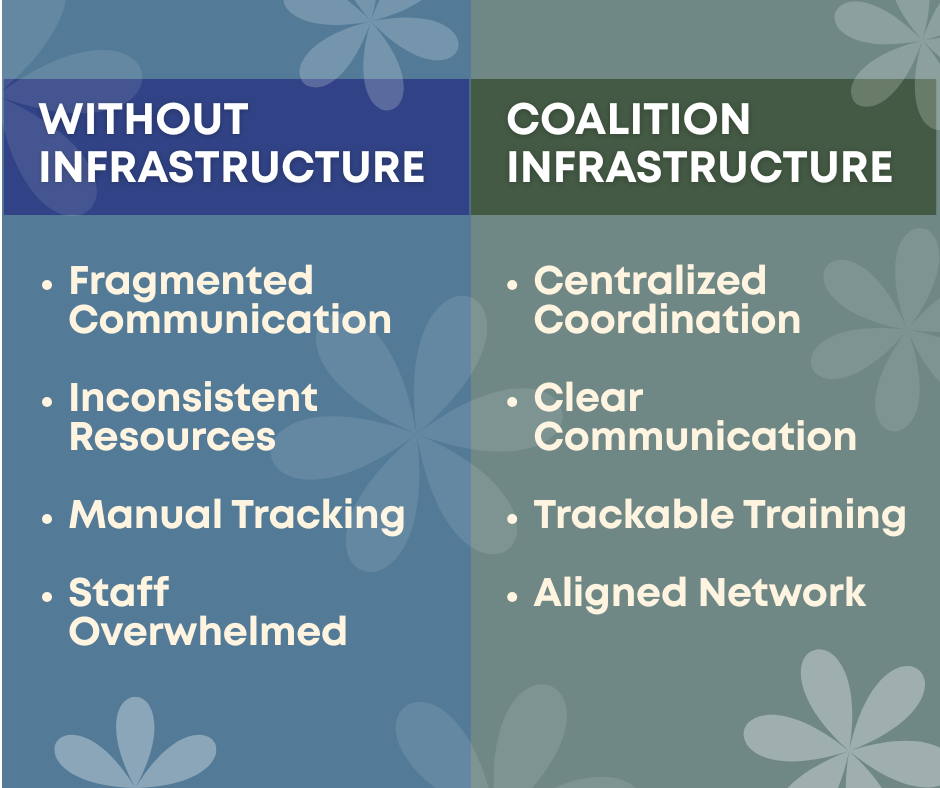
But without the right infrastructure, that work becomes harder to sustain. When coordination is fragmented:
When infrastructure supports the work:
When coordination is fragmented, even the most committed coalitions struggle to maintain alignment across their network. However, with the right infrastructure, that work becomes not just manageable but sustainable.
Coalition Manager gives coalitions the tools to support their members, standardize processes, and operate as a cohesive system.
See how Coalition Manager can support you. Book a demo today!
Coalition infrastructure refers to the systems, tools, and processes that enable networks of organizations to coordinate effectively. This includes member management, communication, training, resource sharing, and standardized workflows that help coalitions operate as cohesive systems.
Coalitions work with independent organizations that often have different funding sources, requirements, and internal systems. This creates challenges around alignment, communication, and consistency, especially when coordination relies on disconnected tools.
Coalitions need infrastructure designed for coordination, not case management. This includes tools for managing members, tracking training and technical assistance, distributing resources, supporting consistent processes, and maintaining clear communication across the network.
Case management software is designed to track individual client interactions and services. Coalition infrastructure, on the other hand, is designed to support coordination across organizations, focusing on members, communication, training, and shared processes rather than individual cases.
Coalition Manager supports coalition operations by providing tools for member management, training and technical assistance tracking, communication, and standardized processes. It is designed to help coalitions align their networks and operate more effectively without replacing the systems used by individual member organizations.